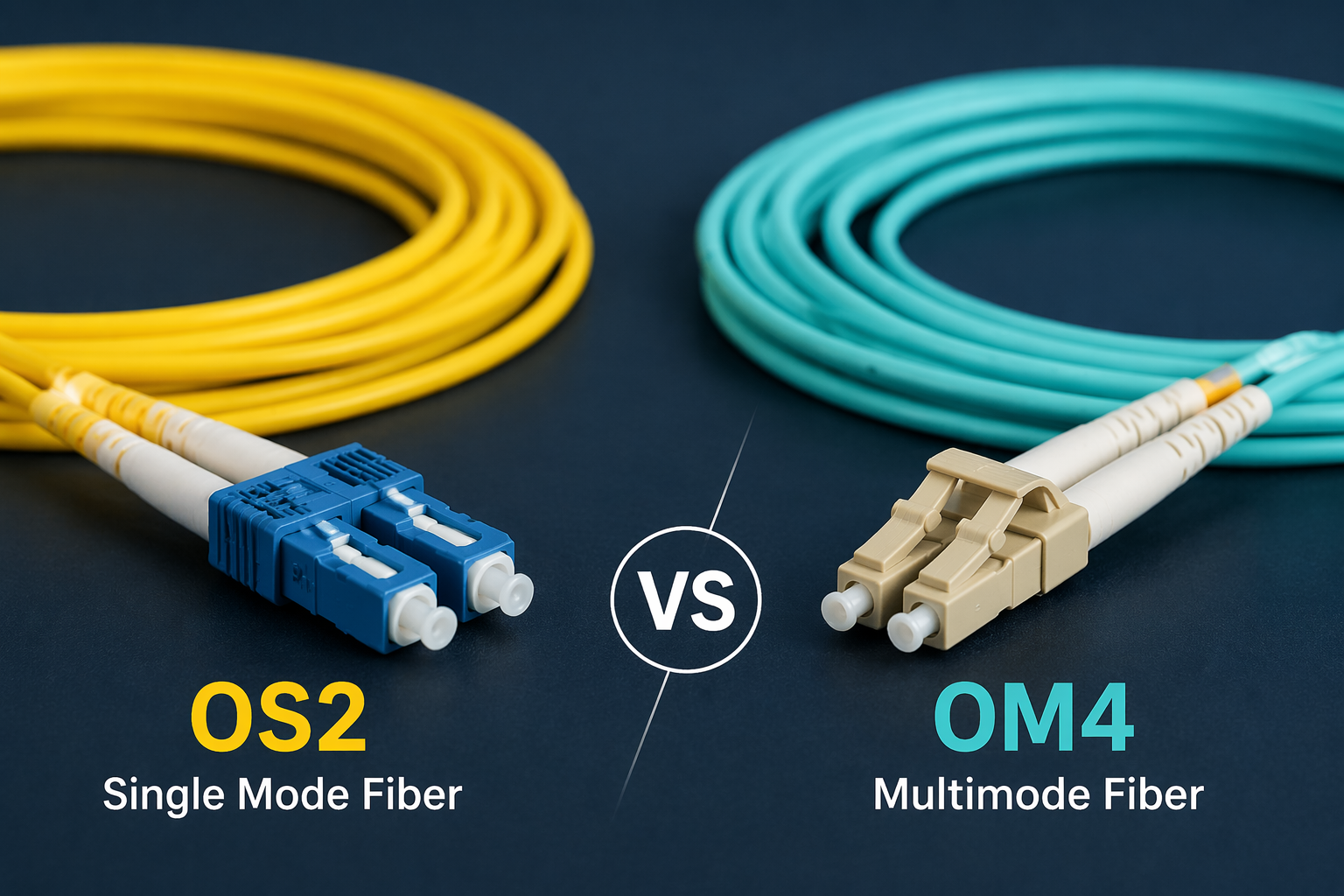
When designing or upgrading a network, choosing the right type of fiber optic cable is an important decision. The difference between single mode and multimode fiber affects how far your signal can travel, how much data it can carry, and how much your overall solution will cost.
Although both types of fiber are used to transmit data using light, they behave very differently. Understanding these differences will help you make the right choice for your specific situation.
What Is the Difference Between Single Mode and Multimode Fiber?
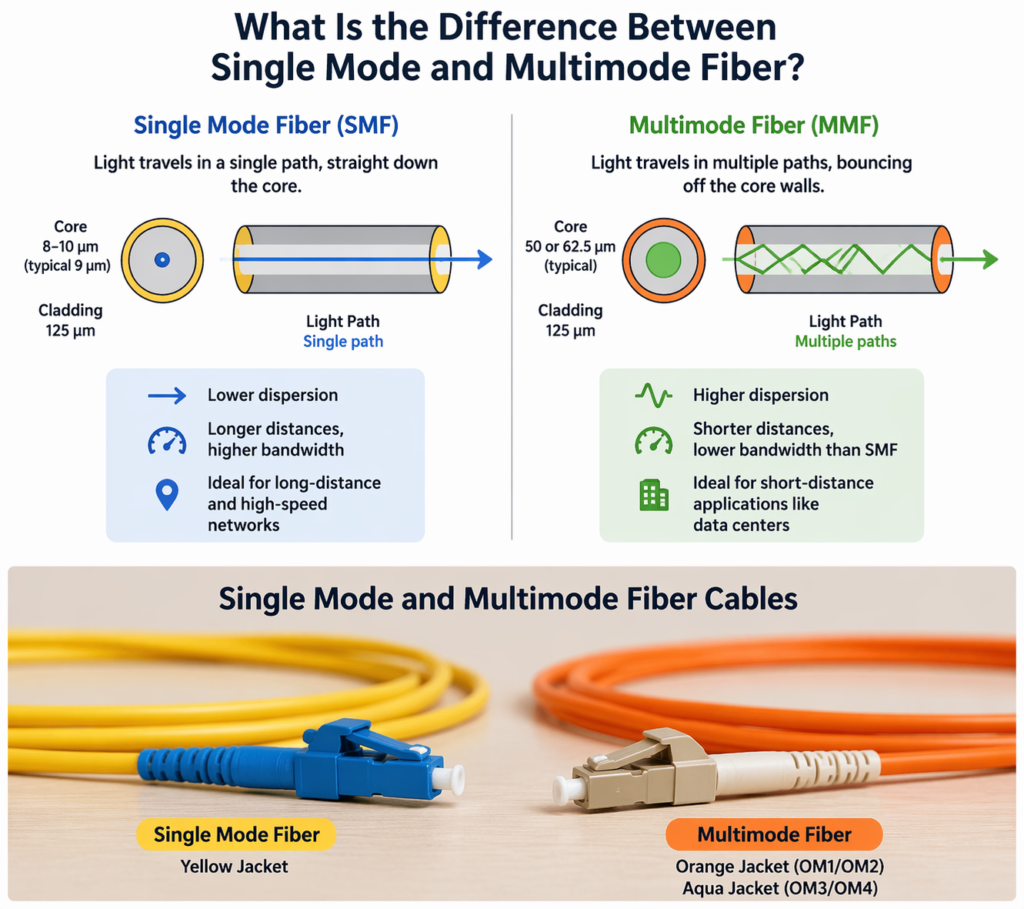
The main difference between single mode and multimode fiber lies in how light travels through the core of the cable.
Single Mode Fiber (SMF) has a very small core (around 9 microns), allowing light to travel in a single path.
Multimode fiber, on the other hand, has a much larger core, usually 50 or 62.5 microns. This allows multiple light signals to travel through the cable at the same time, each taking a slightly different path. While this makes the system easier and cheaper to implement over short distances, it also introduces distortion over longer distances, which limits performance.
Distance and Performance
One of the most noticeable differences between single mode and multimode fiber is the distance each can support.
Single mode fiber is designed for long-distance communication. It is commonly used for connections that span kilometers, such as links between buildings, campuses, or even cities. Because the signal remains clean over long distances, it is also well suited for high-speed applications.
Multimode fiber is typically used for shorter distances. In most practical scenarios, it is limited to a few hundred meters, depending on the data rate. This makes it a common choice inside buildings or within data centers, where devices are located relatively close to each other.
As network speeds increase, the maximum distance supported by multimode fiber decreases. This is an important consideration if you expect your network to grow in the future.
Distances and supported speeds vary significantly between single mode and multimode fiber types. While multimode standards such as OM1 through OM5 are designed for shorter ranges, single mode fiber like OS2 supports much longer distances across all common speeds. The table below provides a practical overview based on typical Ethernet standards.
| Fiber Type | 1Gb | 10Gb | 25Gb | 40Gb | 100Gb |
|---|---|---|---|---|---|
| OS2 (Single Mode) | up to 160 km | up to 120km | up to 10–40 km | up to 10–40 km+ | up to 80km+ |
| OM1 (Multi Mode) | up to 275 m | up to 33 m | not supported | not supported | not supported |
| OM2 (Multi Mode) | up to 550 m | up to 82 m | not supported | not supported | not supported |
| OM3 (Multi Mode) | up to 1 km | up to 300 m | up to 100 m | up to 100 m | up to 70 m |
| OM4 (Multi Mode) | up to 1 km | up to 400 m | up to 150 m | up to 150 m | up to 100 m |
| OM5 (Multi Mode) | up to 1 km | up to 400 m | up to 150 m | up to 150 m | up to 150 m |
Actual distances can vary depending on the specific transceivers, cabling quality, and network design. Always verify compatibility with your vendor when planning a deployment.
Wavelength and Light Source
Another important distinction is the type of light source used to transmit data.
Single mode fiber relies on laser-based optics, typically operating at wavelengths such as 1310 or 1550 nanometers. These lasers are precise and powerful, which is why they are capable of transmitting signals over long distances with minimal loss.
Multimode fiber uses LED or VCSEL-based light sources, usually around 850 nanometers. These components are less expensive and easier to manufacture, but they are also less precise. As a result, they are better suited for short-range communication.
This difference in technology is one of the main reasons why single mode transceivers tend to be more expensive than their multimode counterparts.
Bandwidth and Scalability
Bandwidth is another area where single mode fiber has a clear advantage.
Because single mode fiber avoids the issue of multiple light paths interfering with each other, it can support extremely high data rates over long distances. It is commonly used for 10G, 25G, 100G, and even higher speeds, and it remains a strong choice for future network upgrades.
Multimode fiber can also support high speeds, but only over shorter distances. As speed requirements increase, the usable distance becomes more limited. This makes multimode a practical choice for current needs, but less ideal for long-term scalability.
For organizations planning to expand or upgrade their infrastructure over time, this difference can play a significant role in the decision-making process.
Costs Consideration
Cost is often one of the first factors people consider, but it is important to look at the complete picture.
At the cable level, single mode fiber is often less expensive than multimode fiber. However, the optics used with single mode fiber are typically more expensive because they rely on laser technology.
Multimode solutions usually have cheaper transceivers, which can make them more attractive for short-distance deployments where many connections are required.
When looking at total cost, distance plays a major role. For short links, multimode is often the more economical option. For longer distances, single mode becomes more practical and can even be more cost-effective over time, especially when considering future upgrades.
When to Use Single Mode or Multimode Fiber
In practice, the choice between single mode and multimode fiber depends on your specific use case.
Multimode fiber is commonly used in environments where distances are short and cost efficiency is important. This includes data centers, office networks, and server rooms. It is a reliable and cost-effective solution when the physical distance between devices is limited.
Single mode fiber is better suited for longer distances and situations where performance and scalability are critical. It is widely used for campus networks, telecom infrastructure, and high-speed backbone connections. It is also a strong choice when future growth is expected, as it can support higher speeds without needing to replace the cable.
Q&A: Single Mode vs Multimode Fiber
Q: What is the main difference between single mode and multimode fiber?
A: The main difference is how light travels through the fiber. Single mode uses one path for long-distance transmission, while multimode uses multiple paths, which limits distance and performance.
Q: Is single mode fiber better than multimode?
A: It depends on the application. Single mode is better for long distances and future scalability, while multimode is often more cost-effective for short distances.
Q: Why are single mode transceivers more expensive?
A: They use laser-based technology, which is more precise and costly to produce than the light sources used in multimode systems.
Q: Can you mix single mode and multimode fiber?
A: In most cases, they cannot be used together directly. Specialized equipment is required, and even then it is not always recommended.
Q: Which fiber should I choose?
A: For short distances and lower upfront cost, multimode is usually sufficient. For longer distances and long-term flexibility, single mode is generally the better choice.
Final Thoughts
Both single mode and multimode fiber play an important role in modern networking. The right choice depends on your distance requirements, budget, and future plans.
For short, contained environments, multimode fiber remains a practical and efficient solution. For longer distances and networks that need to grow over time, single mode fiber offers greater flexibility and long-term value.